Last updated on August 1, 2026
Socks manufacturing (yes, that’s a real phrase, and no, it doesn’t involve tiny sweatshops full of grandmothers with knitting needles) is the 6-step process of turning yarn into finished socks: pattern coding → yarn preparation → knitting → linking/sewing → boarding → pairing & labelling. The whole thing takes 7–10 days for a 100-pair custom order, involves 200-needle machines knitting in circles, and ends with a sock that hopefully doesn’t sag like a disappointed accordion. (We’ll explain that metaphor later.)
Frequently Asked Questions
Q: How long does it take to manufacture custom socks?
Typically 7–10 days for production after sample approval, plus shipping. Small orders on our flexible line are actually faster than 1,000-pair runs because the line is built for speed at low volume. See our custom socks order details guide for the full timeline.
Q: What yarn is best for custom socks?
Depends on use case. Combed cotton is the everyday workhorse. Merino wool for winter. Bamboo for silky hand feel. Polyester blends for athletic durability. There’s no single “best” — there’s best-for-your-brand. Read our full sock materials guide for the breakdown.
Q: How much does it cost to manufacture socks?
Per-pair price drops with volume: 100 pairs is the baseline (100%), 500 pairs ~75–80%, 1,000 pairs ~65–70%, 3,000+ pairs ~55–60%. Setup cost is fixed, so more pairs = lower per-pair cost. Request a quote for real numbers.
Q: Where are most socks manufactured?
China produces the majority of the world’s socks, with major manufacturing hubs in Zhejiang and Guangdong provinces. Other significant producers include Turkey, Pakistan, and Italy (premium segment). MeetSocks is based in China and ships globally.
Q: Is sock manufacturing profitable?
Yes, if you pick the right price tier and channel. Margins are tight at the bottom (commodity socks) and comfortable at the top (premium custom brands). Most profitable sock brands sit in the $12–25 retail range with custom design and strong branding. The manufacturing side is volume-driven; the brand side is margin-driven.
Q: Why do my sock logos look pixelated?
Because a sock is knitted in a circle of 200 needles = 200 pixels. Your 1920×1080 screen design gets compressed into 200 pixels wide, and the jagged edges are unavoidable. We adjust the aspect ratio (1.3–1.7× taller) to compensate, but pixelation is physics, not quality. See the Pattern Coding section below.
Q: What’s the difference between hand-linking and machine-linking?
Hand-linking is the traditional method — a worker manually matches each loop of the toe seam. Slow, expensive, but produces a flat, nearly invisible seam. Machine-linking is faster and cheaper, with a slightly bulkier seam. Our all in one automated sock knitting machines now do both knitting and linking in one automated pass — no seam line at all. See the Linking section.
Q: Can I get socks without a toe seam?
Yes. Our all in one automated sock knitting machines knit the toe closed during production, eliminating the seam entirely. The result: no hard seam line rubbing against your toes. Costs slightly more in machine time, saves labor, and feels noticeably better on the foot.
Socks manufacturing is not a high-tech industry, but it involves many detailed processes. Each section of the production must coordinate with each other to ensure quality requirements and time-controlling. In this post we will talk about socks manufacturing process in detail.
Overview of socks manufacturing process
The following image shows how socks are manufactured in a typical socks factory in China. We follow the process and continue to offer our customers like SockCustom headless service so they can focuse on branding, marketing and customer caring.
The whole socks manufacturing process does involve many steps, and the coordination between these steps makes the whole process time-consuming. Sorting out all steps above, there are overall 7 steps that we will mainly talk about as follows:
- Pattern coding
- Yarn preparation
- Knitting socks
- Linking/Sewing socks
- Boarding
- Pairing&Labelling socks
1. Pattern coding
What our clients provide us are the sock designs, however sock knitting machine are not that intelligent to read the designs directly. A professional coding team who are familiar with sock pattern and mahine mechanism will do this job. They will transfer your vector designs into bitmap designs and then codes that the knitting machines can read. Every pixel of the bitmap design means a thread with the specific color will be knitted through.
Different needles of knitting machine means the widths of flat bitmap designs are different, 96N, 144N, 168N, 200N of machines means the widths are 96, 144, 168, 200 pixels, respectively. And the limit of threads count is the reason why socks can’t present gradient or detailed patterns.
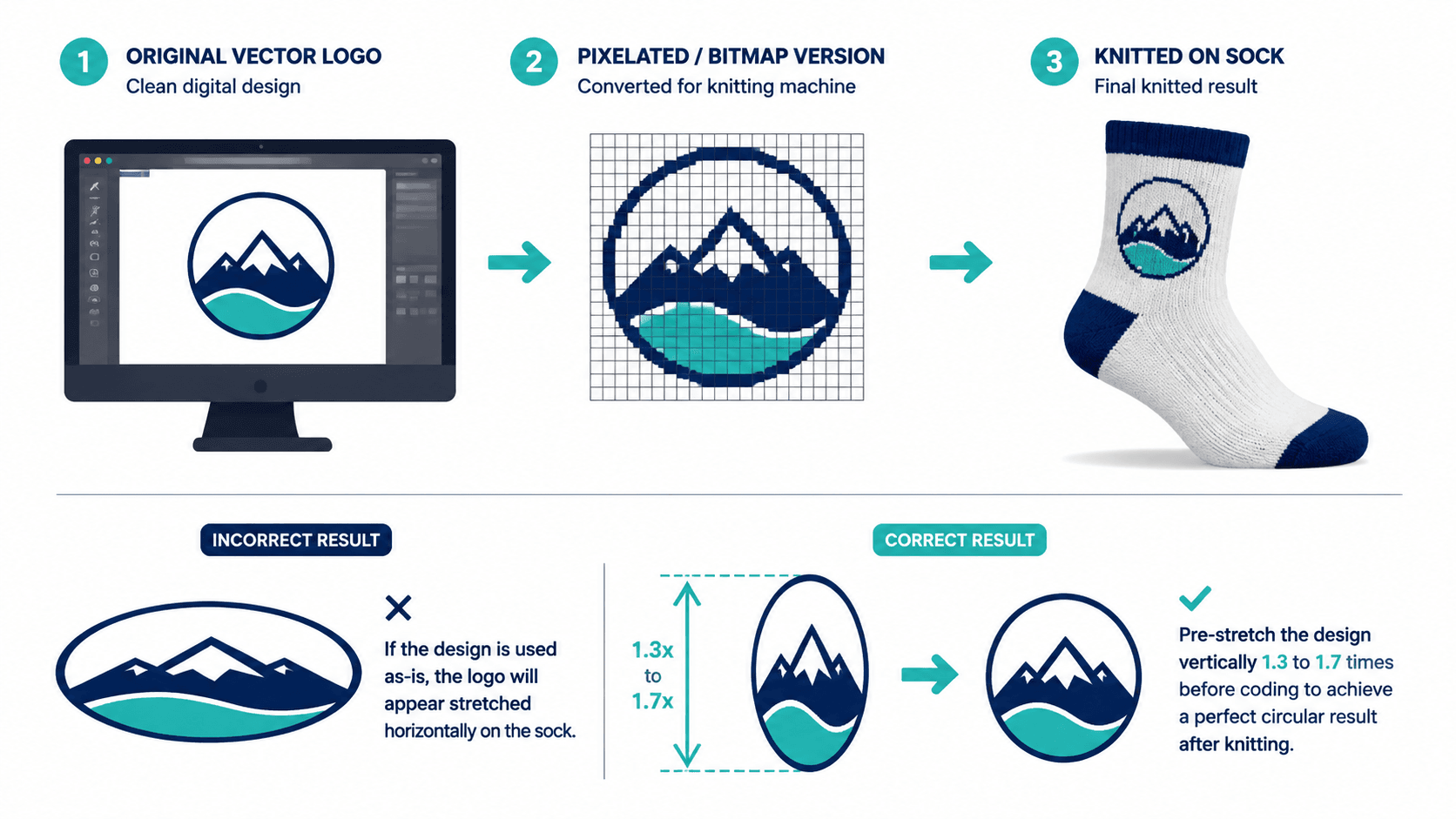
The Pixel Aspect Ratio Problem (Or: Why Your Circle Became an Ellipse)
Here’s where most first-time brand owners panic. Your designer sends a perfect vector logo. We convert it to a bitmap. The machine knits it. You open the sample and… the circle is an ellipse. The square is a rectangle. Something went wrong, right?
Wrong. Something went exactly as physics dictates.
Remember: each pixel in the bitmap = one knitted stitch. But a stitch is not square. A stitch is wider than it is tall — roughly 1.3 to 1.7 times wider, depending on yarn, tension, and needle count. So if we map your design pixel-for-pixel without adjustment, the knitting stretches it horizontally, and your perfect circle comes out as a sad, flattened ellipse. (Like a pizza that’s been sat on.)
The fix: we pre-distort the design by stretching it vertically 1.3–1.7× before converting to bitmap. The stretched version looks wrong on screen, but knits into the correct proportions. The exact multiplier depends on:
- Yarn thickness (thicker yarn = wider stitch)
- Needle count (200N vs 168N vs 144N)
- Stitch tension
- Terry loop presence (terry changes the aspect ratio)
This is why pattern coding is a job for experienced technicians, not a software filter. It often takes 2–3 test adjustments to nail the ratio for a new design. Think of it like tuning a guitar by ear — you get close, then fine-tune until it sounds right.
Why Sock Logos Always Look Pixelated (The 200-Pixel Reality)
A sock is knitted in a circle. A standard sock machine has 200 needles, which means your entire design, all the way around the sock, is rendered in 200 pixels wide. Your computer screen is 1920 pixels wide. We’re compressing your design into roughly 10% of the resolution you’re used to seeing.
The result: jagged edges on logos, text, and curves. A straight line looks like a staircase. A circle looks like a stop sign made of Legos. This isn’t a defect — it’s the physical limit of needle knitting. There’s no “high-res sock” setting. More needles (like 400N machines) improve resolution, but even then, you’re working with hundreds of pixels, not thousands.
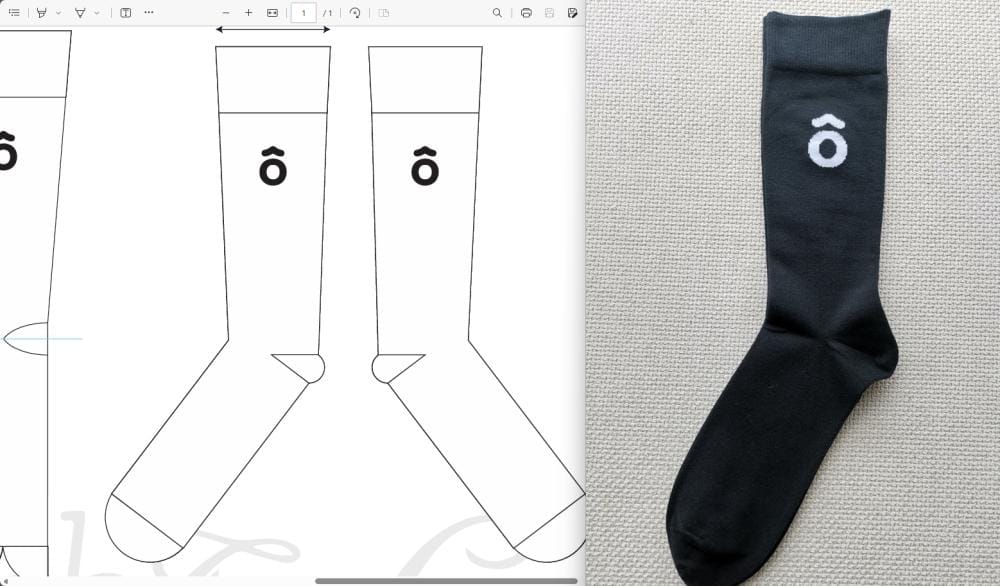
The images below show a simple logo: first as it appears in the bitmap design, then as it actually knits out. Look closely at the second image — the edges are jagged (stair-stepped). That’s the 200-pixel reality, and every sock factory on Earth deals with it.
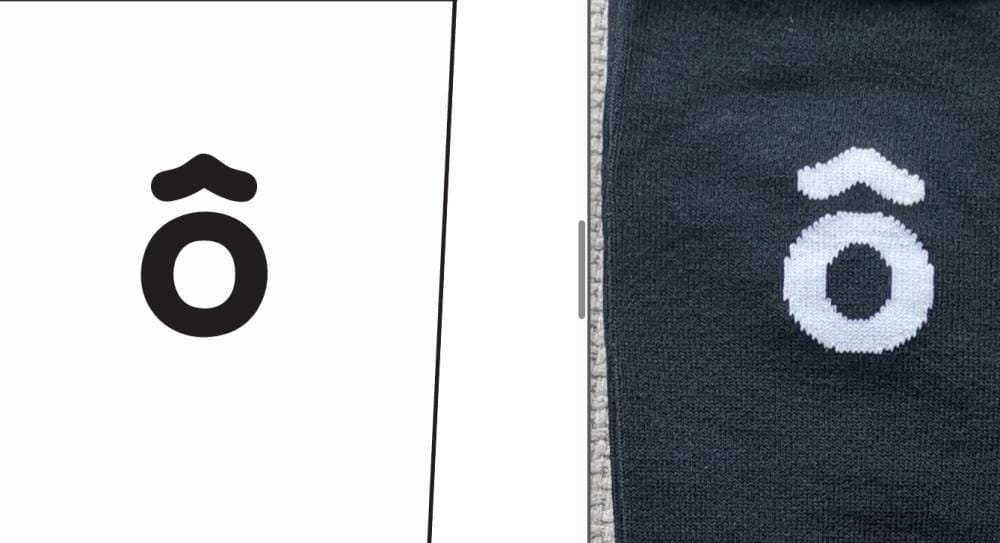
If you’ve ever tried to draw the Mona Lisa with Lego bricks, you understand the constraint. The art is in working with it, not against it.
2. Yarn Preparation
In the order details we have confirmed 2 important things regardign yarn: Composition and Colors.
On how to choose a proper composition for your socks.
We have also writtern a post about yarn color accuracy and we suggest using pantone tcx colors.
For normal and combed cotton, we have over 1000 colors in stock that are able to match your pantone colors.
For other yarn like merceized cotton, wool, etc, we will make custom dyed yarn according to your specified pantone tcx colors.
Yarn Count: Choosing the Right Thickness
Material is half the story. Thickness (yarn count) is the other half — and it’s the part that confuses most brand owners.
If you’re a textile insider, you can specify exactly: “40s combed cotton, 2-ply.” Done. But if you’re a brand operator who just wants good socks, here’s the plain-English version:
- Summer socks (thin, breathable): We use fine yarn like 40s, no terry loop. Think dress socks that disappear in your shoe.
- Winter socks (thick, warm): We use 21s or 32s yarn, often with terry loop (that fuzzy inner layer that traps heat). Like wearing a sleeping bag on your foot.
- All-season socks (medium): 32s yarn, no terry. The everyday workhorse — what most commercial socks use.
Yarn count works like pasta (yes, we’re using this analogy again, it works):
- 21s = fettuccine (thick, chunky, winter weight)
- 32s = spaghetti (medium, everyday)
- 40s = angel hair (fine, dressy, summer)
The easiest method: if you’re not sure what to specify, find a sock you already love the feel of, and mail it to us. We’ll reverse-engineer the yarn count, material, and technique. No technical knowledge required — just good taste in socks.
3. Knitting socks
Using programmed codes in step 1, multitude of needles then knit the various threads into a series of interlocking loops. Computerized sock knitting machines work at high speeds and can easily be programmed to produce a wide variety of socks. 1st inline-inspection is implemented here to avoid mistakes like length, trimming, interlocking etc. The heel is also shaped during knitting — a reinforced heel with Y-stitching greatly improves durability for sports and daily wear.
How Pattern Coding Drives the Knitting Machine
Steps 1 and 3 are not separate processes — they’re deeply connected. Here’s how:
The bitmap from Step 1 isn’t just a picture. It’s a set of instructions that tells the knitting machine exactly what to do at every position, on every rotation. Different colors in the bitmap represent different yarns. When the bitmap is loaded into the machine, those colors map to specific yarn feed channels (think of them as ink cartridges in a printer — each channel feeds a different yarn).
As the machine’s cylinder rotates, it reads the bitmap row by row. When the cylinder reaches a specific position, the bitmap says “now feed Yarn A (the red channel) here” — so the machine engages that yarn feed, knits a few stitches, then switches to Yarn B when the bitmap color changes. This is how patterns, logos, and terry loops are built into the sock structure itself.
The takeaway for brand owners: you don’t need to understand any of this. Our technicians handle the bitmap-to-machine translation. You tell us the effect you want (“logo here, terry sole, reinforced heel”), and we make the machine speak the right language. Think of the bitmap as sheet music and the knitting machine as the piano — we’re the pianist.
4. Linking/Sewing socks
Knitting makes a cylinder tube, thus we need to the sewing process in order to link the seperated toe parts together. This is usually done by machine, which is quick. Sometimes this process is also done by manual work, which costs a lot of time. Since the socks are sewed one by one, our skilled workers can easily find defective socks and clear them away from the majority, which is the 2nd inline-inspection.
The Toe Seam Revolution: All in One Automated Sock Knitting Machines
Linking (also called toe closing) is one of the oldest processes in sock manufacturing — and historically, the most labor-intensive. After knitting, the toe of the sock is open. A worker (or machine) must stitch it closed, loop by loop. It’s finicky, slow, and leaves a seam line across the toe.
That seam line matters more than you’d think. On a traditional linked sock, you can feel a hard ridge across your toes. For most people it’s a minor annoyance. For athletes and people with sensitive feet, it’s a dealbreaker. (If you’ve ever done a 10K run and finished with toe blisters exactly where the seam sits, you know.)
In recent years, we’ve introduced all in one automated sock knitting machines that do both jobs in a single automated pass: they knit the sock and close the toe, with no human intervention between the two steps. The result:
- No hard seam line — the toe is closed as part of the knitting, not stitched afterward
- Flat, smooth toe — nothing rubs against your toes
- Lower labor cost — no manual linking step
- Higher machine cost — the machines are more expensive, but the per-sock cost drops at volume
This is arguably the biggest innovation in sock manufacturing in the last decade: replacing a skilled manual operation with an automated one, and improving the product at the same time. The machine costs more, the worker costs less, and your toes win.
For more on toe seam types and how to choose, see our toe seams guide.
5. Boarding socks
The boarding process is actually implemented to keep the socks in good shape, so that they can easily be paired and packed. One more thing to note here is that the boarding step also keep the socks clean and soft by experiencing steams under a fixed pressure and temperature. After boarding, the socks will naturally dryed.
Custom Boarding Boards & Special Treatments
Beyond the standard boarding process, we also offer custom-shaped boarding boards — including the gradient-pressure boards used for graduated compression socks. If your sock has a specific shape or compression profile, the boarding board is tailored to match.
This stage is also where we apply functional finishes if your brand requires them:
- Antibacterial treatment — silver-ion or other antimicrobial coatings, for socks that need odor control (athletic, medical, travel)
- Softening treatment — fabric softeners applied during boarding for a silkier hand feel
- Moisture-wicking finish — for performance socks that need to pull sweat away from skin
These treatments happen during boarding because the heat and steam help the treatment penetrate the fibers evenly. It’s like conditioning your hair in a hot shower — the warmth opens the fibers and lets the good stuff in.
6. Pairing&Labelling socks
This is the final inspection step to see if there is any deflection on the socks. The left and right socks are paired together and then passed on to be private labelled. You can choose hangtags or bands to label your socks.
Three Stages of Quality Inspection
Quality control isn’t a single checkpoint — it’s built into the entire process:
- In-line inspection during knitting: Workers patrol the knitting machines, checking for length errors, trimming issues, and interlocking defects in real time.
- Pre-boarding inspection: After knitting and linking, socks are visually inspected for pattern sharpness, structural integrity, and overall finish before boarding.
- Final pairing inspection: During pairing and labeling, each pair gets a final visual check — left and right socks are matched, defects are caught, and only good pairs move to packaging.
Three checkpoints, three chances to catch defects. Because nothing ruins a brand faster than a customer opening their first pair and finding a hole.
Custom Packaging Options
Packaging is the last manufacturing step and the first thing your customer sees. We offer:
- Hangtags (header cards): Custom-printed cardboard headers with your brand design
- Bands (waist seals): Paper or fabric bands wrapping the sock pair
- Gift boxes: Premium packaging for gift socks and subscription boxes
- Clear poly bags: Basic protection for retail and shipping
- Custom hooks: For retail display compatibility
Tell us the unboxing experience you want, and we’ll match it.
Sock-to-Card Attachment: The New Tack-Machine
Here’s a small but meaningful upgrade. Traditionally, socks are attached to hangtags using a plastic staple gun — a metal staple with a plastic back, pinning the sock to the card. It works, but:
- The plastic staple is single-use waste
- Removing it requires tools or fingernails
- It can damage the sock fiber at the puncture point
We’ve introduced a new tack machine that uses a thread tie instead of a plastic staple. The thread ties the sock to the card, and removal is as simple as pulling the thread tail — the sock releases cleanly, no tools, no damage, no plastic waste.
Why it matters: less plastic, easier removal, no fiber damage, and it’s fully recyclable. Small change, big upgrade for eco-conscious brands. Your customers will notice, even if they don’t know why.
Conclusion
Check our socks manufacturing blog to find more about socks manufacturing process and socks oem service.
Also there is a video about socks knitting process here: